




Farming.
Forty chapters of television have used Tractoring, Sheeping, Porking, Unfarming, Council-ing and Counselling, and have never once used the plain word. So it is free, and it belongs to the only thing big enough to need it: a farming game whose signature mechanic is that the farming goes wrong.
There is no game
This is a design document published as a website. There is no game, no build, no publisher and no release date. Every cost, headcount and duration on these pages is an estimate with its working shown, produced by an unsolicited third party with no licence, no endorsement and no relationship with anybody named on it.
Plant, Tend, Cock It Up, Harvest, Trade, Build.
Six stages, one season, and about forty minutes of attention spread across a fortnight of real time.
Plant
Choose a crop, a field and a date, and pay for the seed before you know anything. Three to five minutes of real attention, and every trade-off stated before you commit.
Tend
Six input windows across the season. Nitrogen, fungicide, slugs, the flag leaf spray that costs the most and does the most. Missing one costs yield and nothing else.
Cock It Up
One cycle in six goes partly wrong. One in twenty goes badly wrong. Seven times out of ten you can see exactly why, and there is nothing on sale that makes it less likely.
Harvest
The number arrives with its working shown — establishment, tillers, ears, the weather record, and every decision you took. A bad harvest teaches; a mysterious one only annoys.
Trade
Sell it, store it, or forward-sell part of it before you know what you have. Three routes, no correct answer, and a price series driven by in-game supply rather than a dice roll.
Build
Turn it into a grain store, a shop, a brewery, a pub. Everything goes through Alan, everything runs over, and the overrun is capped and disclosed.

Cocking It Up is the whole point.
Every farming game on the market is a machine for turning time into an ascending number. Crops grow, barns fill, the number goes up, and the only variable is how fast. Nothing ever fails, because failure tests badly and the retention team can see it in the graph within a week.
This farm’s entire public identity is the opposite. The first commercial batch of lager was thrown away for being merely fine. A batch of cider was recalled with a statement that began "we completely cocked up", and sales went up afterwards. The farming made a hundred and forty-four pounds in year one and lost about five thousand in 2024–25. That is the brand, and a game built on it that cannot fail is not built on it at all.
So failure is a stage of the loop rather than an accident inside one. It has a rate, a cause, a salvage path and a share card. What it does not have, anywhere, is a price — nothing sold in this design reduces the chance of it, because the moment failure becomes purchasable the honesty becomes a monetisation surface and the whole thing curdles.
- 1 in 6
- partly wrong
- 1 in 20
- badly wrong
- £0
- the price of avoiding it
The six stages.
Planting
Choose a crop, a field and a drill date, and pay for the seed before you know whether any of…
Tending
The long middle. Nitrogen splits, a fungicide decision at flag leaf, slug pressure after a wet October, and a set…

Cocking It Up
The stage every other farming game leaves out. Roughly one cycle in six goes partly wrong and one in twenty…
Harvesting
The number arrives. Yield is calculated from establishment, tiller count, ear count, the weather record and the decisi…

Trading
Sell it now, store it in the barn and gamble on a spring price, or forward-sell part of it before…
Building
Turn the money into something that changes the next cycle. A grain store, a farm shop, a brewery, a pub.…
The six people, and what each one actually does.
Kaleb
Pay Kaleb and the job that was going to take four hours takes none. He is the game’s only time-skip,…
Charlie
The agronomist and land agent, and the only character whose entire function is to tell you that you cannot do…
Gerald
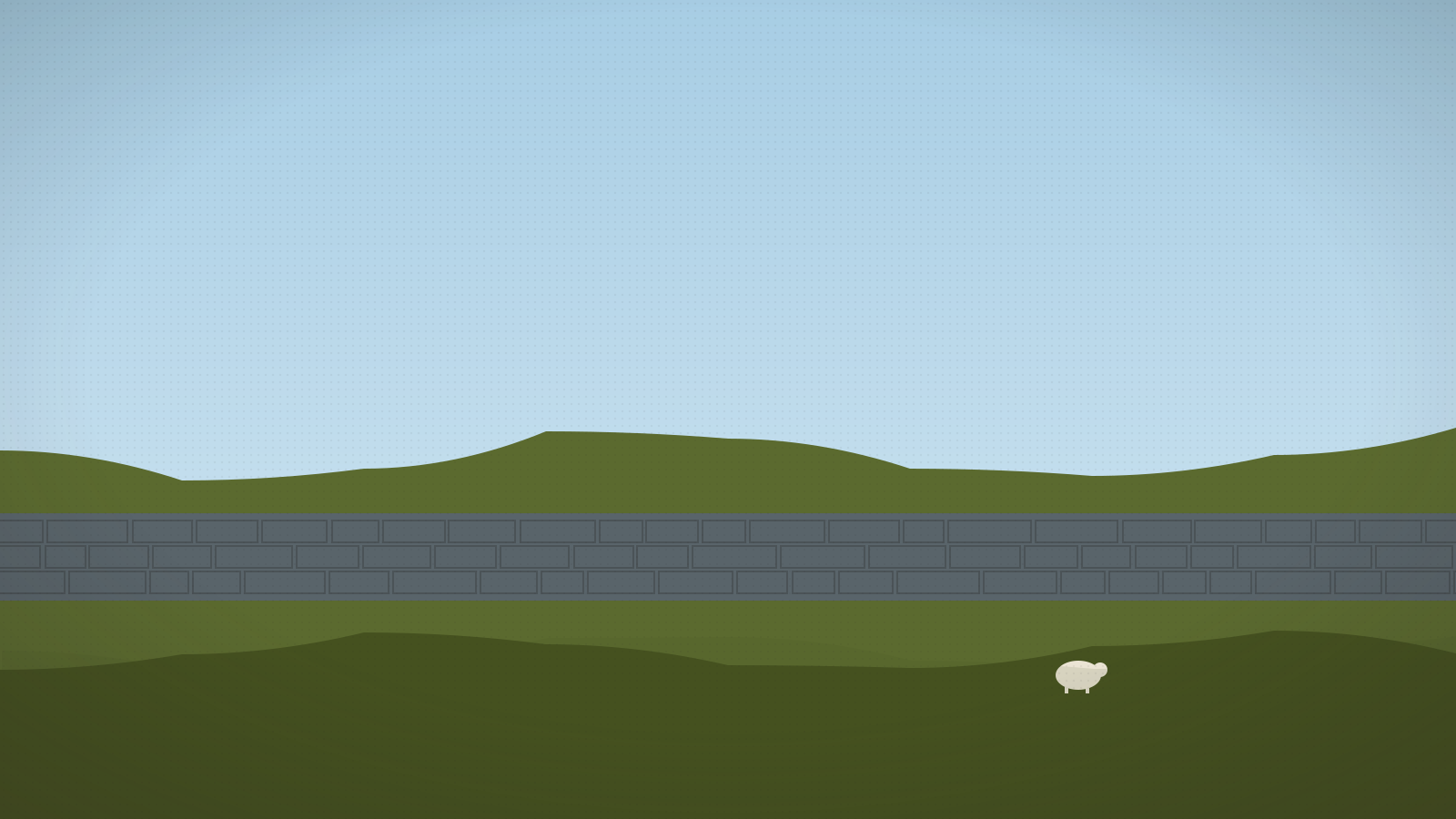
The boundaries. Dry-stone walls by the metre, hedgerows laid rather than flailed, and a biodiversity score that is the…
Lisa
The farm shop, and the multiplier that makes the whole economy work. Raw produce sold at the gate is worth…
Alan
The builder. Everything built in the game goes through Alan, every quote he gives is honest, and every final invoice…
Harriet
Set relief cover before you close the game and the farm carries on without you. Stock is fed, windows that…
What this is, and what it emphatically is not.
| What it is | What it is not | |
|---|---|---|
| Status | A design document rendered as a website | A product, a build, a demo or an announcement |
| The failure | A stage of the loop, with a stated rate | A random punishment you can pay to avoid |
| The money | Coins from harvest, and a premium currency for time and hats | Loot boxes, card packs, or any randomised paid reward |
| The multiplayer | Asynchronous, parish-scale, cooperative | Real-time, global, or competitive against strangers |
| The beer | Absent. There is no Hawkstone anywhere in it | A brand integration waiting for the right rating |
| The children | Assumed to be present, and designed for accordingly | An edge case handled in the terms and conditions |
| The rights | None. Nothing here is licensed or endorsed | A pitch, a proposal or an approach to anybody |
The systems underneath.

The economy
Sources, sinks, the exchange rate, and the argument for having no loot boxes at all.
Progression
No forced tutorial, no penalty for absence, and a lapsed player who returns to a farm rather than a bill.

The weather
The in-game sky driven by the actual weather here, on a twenty-four to seventy-two hour delay, for four reasons.
The vote
Genuine decisions on this farm put to the players, settled months later, free to enter and worth nothing.
The social half, and the compliance half.

Parishes
Parish-scale leaderboards, never global, and no mechanic that requires two people online at once.

Cocked-Up Reels
The game generates a clip of the moment it went wrong, and hands it to you rather than to an…
No beer in it
Why there is no Hawkstone in the game, and why a zero per cent version would be no better.

Children
A mandatory DPIA, high privacy by default, and a maximum penalty of £17.5m or four per cent of global turnover.
The three stages of building it, if anybody ever did.
| Stage 1 — licence in | Stage 2 — the Chapter Game | Stage 3 — native mobile | ||
|---|---|---|---|---|
| Cost | £50,000–200,000 | £250,000–600,000 | £2m–5m | |
| Duration | 3–9 months | 6–12 months | 18–30 months | |
| People | A licensing conversation and a producer | 6–10 | 20–40 | |
| Risk | Lowest here by a distance | Real but survivable | Company-threatening | |
| What it proves | That the audience turns up at all | Retention, economy and the loop | Nothing new — it scales what Stage 2 proved | |
| Gate to the next | Any measurable uptake | D1 retention 45%+ and D30 20%+ | There is no stage four |
The questions this page gets first.
Four questions, and the first one is the important one.
No. It is a design document written as a website by an unsolicited third party. There is no build, no publisher, no licence and no release. Every figure on these pages is an estimate with its working shown.
Because forty chapters of television have used almost every gerund available and never used that one. It is the largest unused word in the naming system, and it belongs to the largest unbuilt thing.
No. CAP rule 18.15 prohibits alcohol advertising in any medium where more than twenty-five per cent of the audience is under eighteen, and a farming game would not survive that test. A zero per cent version is caught by the same threshold under CAP 18.18 to 18.24.
There is none. The player vote is free to enter, rewards a cosmetic of no value, cannot be cashed out and is framed on judgement rather than chance, which is what keeps it outside the Gambling Act 2005.
Start with the loop.
Six stages, the numbers behind each, and the one that no other game in the category has.